
The Leadership Equation for the AI Age
If 2025 was the year when every business conversation seemed to revolve around sustainability, then 2026 is undoubtedly the year of Artificial Intelligence.
Every conference, networking event, board meeting, and LinkedIn feed appears to be dominated by one question:
“What is your AI strategy?”
Like most people, I have a theory.
In fact, I think one of the biggest mistakes we make as humans is overestimating how quickly change happens and underestimating how profoundly it changes us over time. When I look back over my lifetime, there have been very few developments that have had a truly transformational impact on the way we live and work. The internet is one. Surprisingly, Concorde is another.
Now, before you question the comparison, bear with me.
Concorde fundamentally changed what was possible. It proved that travelling faster than the speed of sound wasn’t science fiction. It shifted our perception of what could be achieved. The internet did exactly the same thing for information and communication. Yet despite how revolutionary it was, it didn’t transform the world overnight. It took decades for businesses and individuals to fully integrate it into everyday life. We learned how to use it, how to work with it, and eventually how to depend upon it.
Today, AI feels remarkably similar. The headlines would have us believe that jobs will disappear overnight and entire industries will be replaced by machines. I don’t believe that’s what happens.
I believe AI will change jobs far more than it replaces them.
Several months ago, I heard a quote that has stayed with me. Unfortunately, I can’t remember who said it, but its message was simple:
“AI won’t take your job. Someone who knows how to use AI properly will.”
That statement captures the reality of where we’re heading.
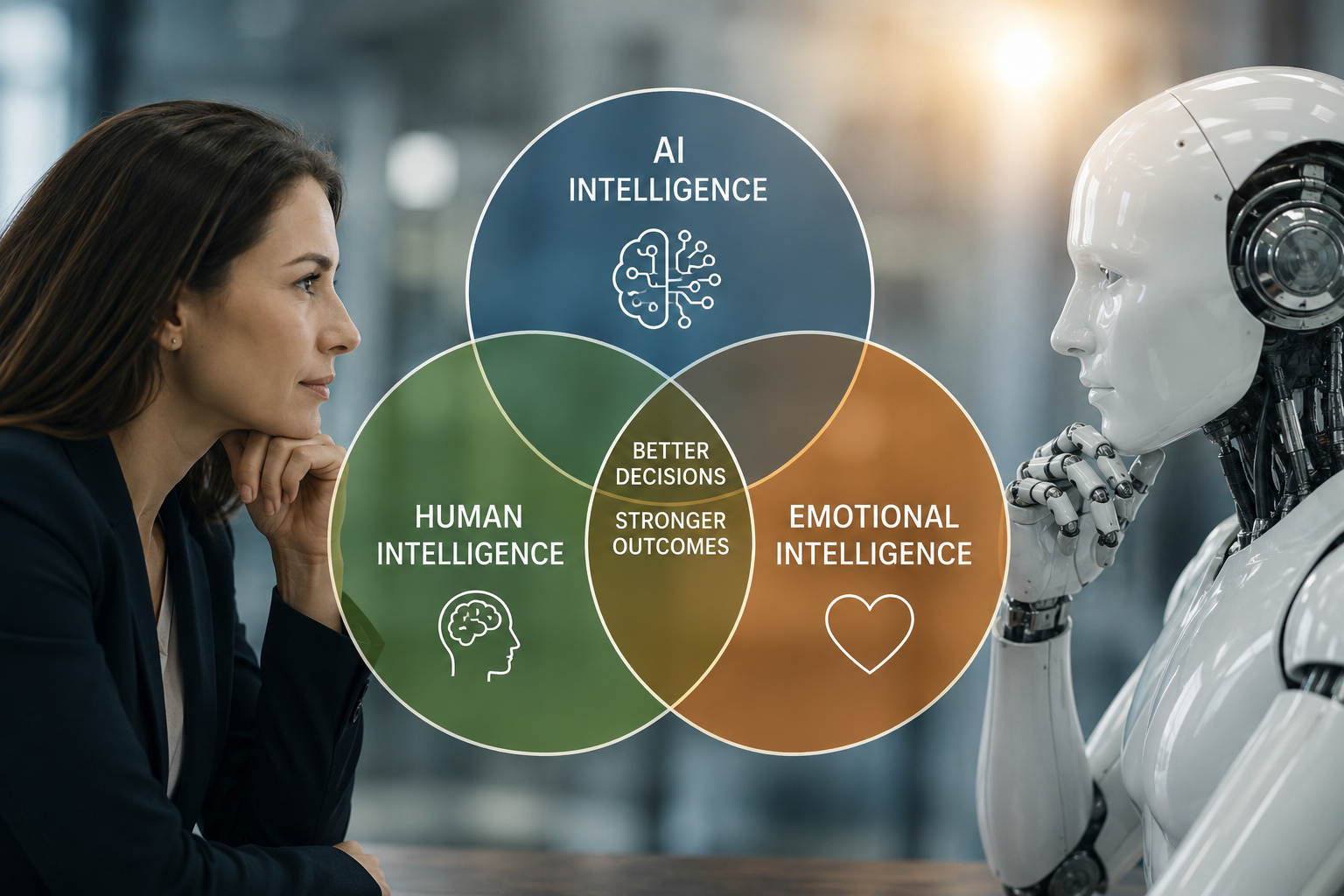
The future doesn’t belong to artificial intelligence alone. It belongs to those who learn how to combine artificial intelligence with uniquely human capabilities.
This is why I believe the leadership equation for the next decade is:
R2 = (AI × HI) × EI
Where:
R2 = Exceptional Results
AI = Artificial Intelligence
HI = Human Intelligence
EI = Emotional Intelligence
In simple terms:
Exceptional results come from combining AI with human intelligence and then amplifying everything through emotional intelligence.
AI: The Accelerator
Artificial Intelligence is rapidly becoming the most powerful productivity tool many organisations have ever seen.
It can analyse data, automate routine tasks, generate ideas, identify patterns, and dramatically reduce the time required to complete complex work. Used correctly, AI allows people to move faster, make better-informed decisions, and focus on higher-value activities.
However, AI has one critical limitation. It doesn’t understand context in the way humans do. It can process information, but it doesn’t possess wisdom. It can generate options, but it doesn’t own accountability. It can provide answers, but it doesn’t truly understand consequences.
This is where Human Intelligence becomes essential.
HI: The Differentiator
Human Intelligence brings judgement, creativity, experience, intuition, and critical thinking.
It is the ability to challenge assumptions. To ask better questions, to connect seemingly unrelated ideas, to recognise opportunities that data alone may never reveal, the organisations that thrive won’t be those with the most AI.
They will be those with the people who know how to use AI to enhance their thinking rather than replace it.
- AI can provide information.
- HI provides interpretation.
- AI can generate possibilities.
- HI determines priorities.
- AI can assist decisions.
- HI owns them.
- EI: The Multiplier
Yet there is a third element that many leaders overlook.
Emotional Intelligence.
In a world increasingly powered by technology, human connection becomes even more valuable.
- Customers still buy from people they trust.
- Employees still follow leaders they believe in.
- Teams still perform best when they feel understood, valued, and engaged.
No matter how sophisticated AI becomes, it cannot genuinely empathise with a struggling employee, inspire a team during uncertainty, or build lasting trust with a client.
That requires Emotional Intelligence.
The leaders who create disproportionate success will be those who combine technological capability with human judgement and emotional awareness.
Because while AI may accelerate performance, EI determines whether people choose to follow.
The Leadership Challenge
The challenge for leaders isn’t deciding whether AI matters., that debate is over. The real challenge is ensuring that AI enhances rather than diminishes the human qualities that create sustainable success.
Leaders must develop organisations where:
- AI improves efficiency.
- Human Intelligence drives innovation.
- Emotional Intelligence strengthens relationships.
Get any one of these wrong and performance suffers, focus solely on AI and you risk becoming efficient but irrelevant, focus solely on people and you risk falling behind competitors who embrace technology, focus solely on emotional connection and you may create a great culture without delivering results.
The magic happens when all three work together.
Final Thought
The future will not belong to AI, nor will it belong solely to people. It will belong to those who learn to combine the strengths of both.
The organisations that achieve extraordinary growth over the next decade will understand that technology is not the replacement for humanity, it is the amplifier of it.
Which brings us back to the equation:
R2 = (AI × HI) × EI
Artificial Intelligence provides the power, Human Intelligence provides the direction, Emotional Intelligence provides the impact.
Master all three, and the results can be extraordinary.
Phil Harland 2026